In August 2025, a fire broke out near A Rúa, in the province of Ourense. By the time it was out, it had burned 44,424 hectares — the largest fire in Galicia's recorded history. Within days, Uña de Quintana and Benuza were burning too. Across Spain, more than 31.000 people were evacuated from their homes.
Spain closed 2025 with 393.079 hectares burned, its worst year since 1994. For the European Union as a whole, it was the most destructive fire season on record, and 43% of everything that burned was in Spain and Portugal. Scientists at World Weather Attribution found that climate change made the fire weather of August 2025 around 40 times more likely. Seasons like these are becoming the pattern.
What a fire leaves behind
The flames are gone within days. What they leave behind lasts far longer. Soil that once held rainwater and fed new growth is left bare and exposed. Animals lose their shelter and their food. Hillsides that sustained life for generations lose much of their capacity to recover on their own.
The damage lands hardest where the fewest people remain. In much of rural Spain, villages are emptying and land goes unmanaged, which leaves more fuel for the next fire. When a fire comes through, it destroys the landscape and pushes out the people still holding on.
Why Bosquia takes its time
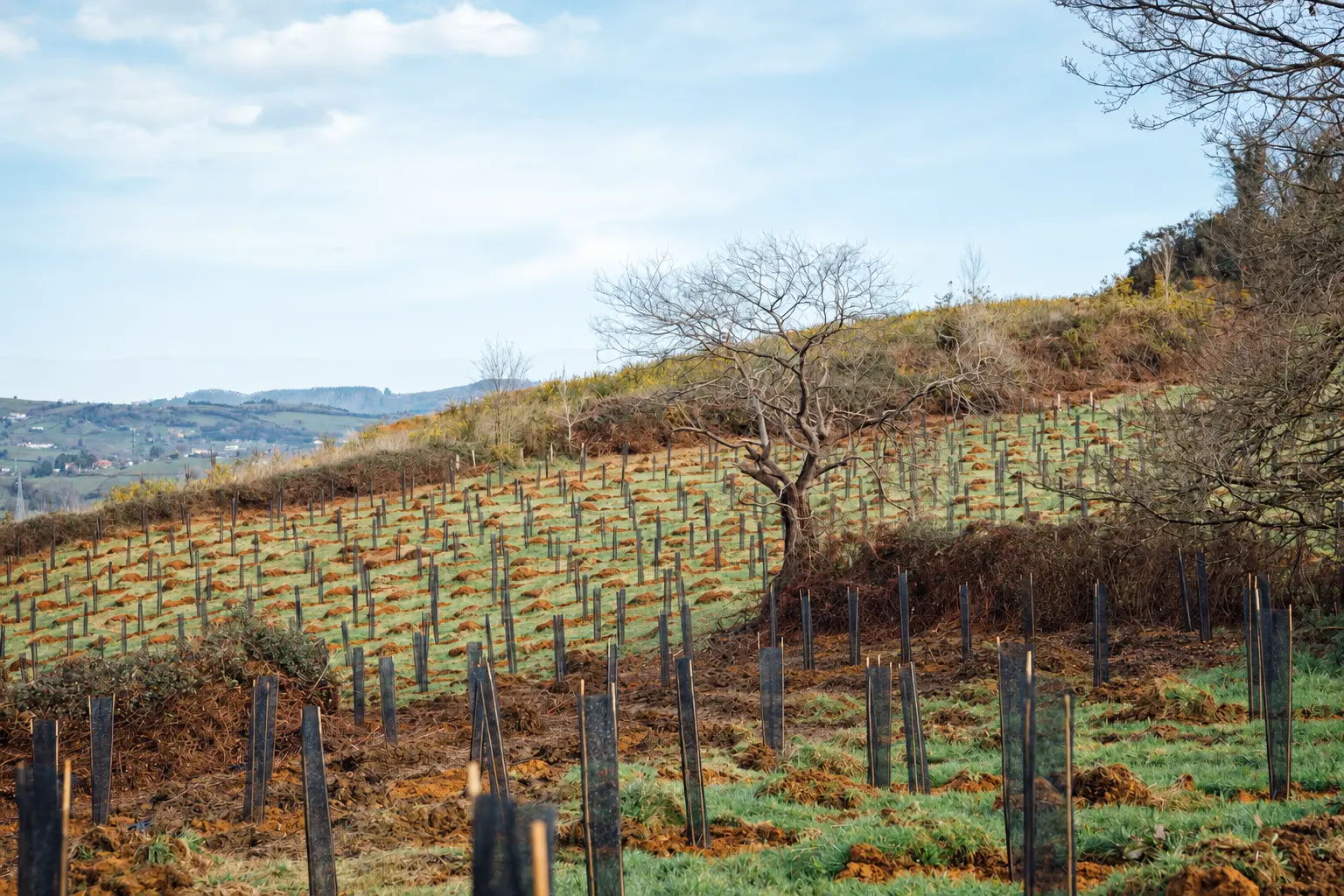
Bosquia Nature, a company from Asturias, has carried out more than 400 forest restoration projects since 2019, for clients including AstraZeneca and Redeia. Its approach starts with patience. Each site is studied first to decide when and how to intervene, and the soil is given its natural regeneration time before anything is planted.
The company is seeking financing to reforest about 50 hectares in Asturias, Galicia and Castilla y León — the regions at the heart of these fires. The estimated cost is 10.000€ per hectare, covering every step: the landowner agreement, site assessment, land preparation, certified seedlings, planting, maintenance and official registration.
The fires were front-page news. Restoring what they took is slower, quieter work: years of planting, tending and waiting for a forest to take hold.
From tree to credit
Every tonne of CO2 a forest captures can be measured, certified and sold. That is the business model behind Bosquia Nature, and it is at the heart of how the company plans to repay the loan it is seeking on Goparity.
As the young trees grow, they draw CO2 out of the air and lock it into wood and soil. Bosquia registers its projects with MITECO, Spain's Ministry for the Ecological Transition. Each certified tonne becomes a carbon credit, and 18% of a project's projected credits can be sold shortly after registration, long before the forest reaches maturity.
The buyers are large companies. Since 2026, large Spanish companies have had to calculate their carbon footprint and publish reduction plans under Royal Decree 214/2025. Offsetting remains voluntary, but these companies now have their emissions in writing and plans to act on them. The market also values carbon removal: in early 2026, credits from removal projects such as reforestation averaged about $22 per tonne, against about $6 for avoidance credits.
What the repayment plan relies on
Repayment of the Goparity loan is planned to come from more than one source. One is the credits from these forests that Bosquia can sell in the loan’s first year. The other is the services Bosquia already sells to companies, such as helping them develop projects and manage their CO₂.Repayments start after a six-month grace period and run for 30 months. The timeline follows how Bosquia earns its best margins: selling certified forest assets parcel by parcel, directly to companies. Those sales take longer to close than selling credits in bulk, so the 30 months give them room to happen.
The loan is also backed by two guarantees. The first is a pledge over the credits of the Forecai Project, a forest in Pontevedra, Galicia, registered with MITECO since 2024 and projected to capture 3,212 tonnes of carbon over 30 years. The second is a pledge over the carbon credits from the new forests this loan will finance.
Each forest Bosquia plants brings life back to land that had lost it. That same forest is what the repayment plan is built on.
Investments in crowdlending carry a risk of partial or total loss of the funds invested.
Written by