
.webp)

5
min read
The women of Sangareni
What does women's leadership actually look like inside a smallholder coffee cooperative in the Peruvian Andes? Not as a policy goal or a certification requirement, but as a daily operational reality, built over two decades by the people who showed up and did the work. This is the story of the women of the Agrarian Cooperative Sangareni.
What does women's leadership actually look like inside a smallholder coffee cooperative in the Peruvian Andes? Not as a policy goal or a certification requirement, but as a daily operational reality, built over two decades by the people who showed up and did the work.
This is the story of the women of the Agrarian Cooperative Sangareni.
The women of Sangareni: producers, managers, and leaders
Rural coffee cooperatives are not always known for women in leadership. Sangareni is a different story.
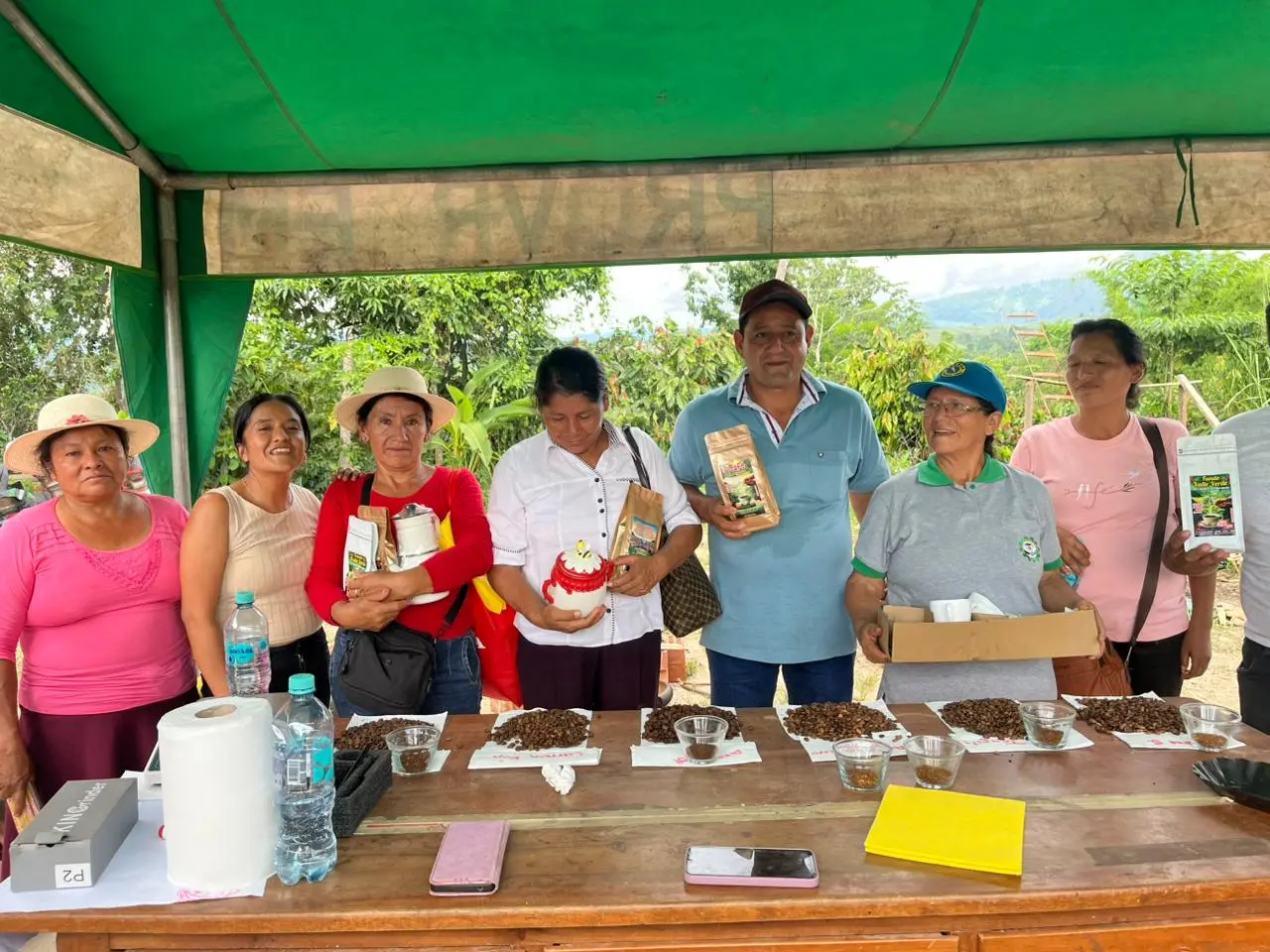
Of the 379 members of Cooperativa Agraria Sangareni - a Fairtrade specialty coffee cooperative in Pangoa, in Peru's central rainforest - 109 are women. They grow coffee, manage farms, sit on the cooperative's governing board, lead the selective harvesting that determines the quality of every cup, and run a dedicated export line sold directly to a buyer in Germany. In Sangareni's own words, they are "producers, managers, and leaders".
That description means a lot more than what it may seem on the surface. Because in Peru's rural coffee-growing communities, women's economic independence is not a given. Access to land, credit, and markets has historically been harder to reach. The cooperative model, when it works well, changes that. At Sangareni, it has.
Every role in the chain
The most visible role women play in Sangareni is in the field. Selective harvesting (the process of picking only the ripest coffee cherries by hand, at exactly the right moment) is one of the most demanding and consequential steps in specialty coffee production. It's the step that most directly determines whether a coffee scores 82 or 85 on the Specialty Coffee Association's 100-point scale. In Sangareni, women lead it.
Beyond the harvest, two women members sit on the cooperative's governing bodies, participating directly in the decisions that shape how Sangareni operates, invests, and grows. Many more manage the financial administration of their households - tracking income, planning for the next harvest season, deciding how cooperative earnings are reinvested. In communities where these decisions have historically been concentrated in male-headed households, that role carries a weight that goes well beyond day-to-day accounting.
The result is a cooperative where women's knowledge, judgement, and labour are present at every stage of the production chain; not as a diversity initiative, but as an operational reality built over two decades.
A coffee line of their own
The most concrete expression of women's leadership in Sangareni is a dedicated export line managed entirely by its women members - produced, processed, and sold directly to a buyer in Germany.
It didn't emerge from a certification requirement or a corporate gender programme. It grew out of the Comité de Mujeres (the cooperative's women's committee) an active, organised group that advocates for women's participation across every level of Sangareni and administers specific funding within the annual Fairtrade Premium Plan for women's education and training.
The export line is what that advocacy produced over time: a direct commercial relationship with an international buyer, independent income for the women who manage it, and a presence in a global market that has long excluded the people most responsible for growing what it sells. For the women who run it, the line is not symbolic. It is a business; one they built, and one they control.
What economic autonomy looks like in Pangoa
To understand why this matters, it helps to understand the context. Pangoa is a district in Peru's Junín region, in the central rainforest where the Andes begin their descent toward the Amazon. Coffee farming here is a multi-generational activity, tied to land, family, and community in ways that are deeply intertwined with questions of who holds economic power.
For a woman in this environment to manage her own certified farm, lead a harvest team, participate in cooperative governance, and sell coffee under her own name to a buyer in Europe is meaningful in ways that extend well beyond the cooperative itself. It changes what is considered possible -for her, for her daughters, and for the community around her.
Sangareni didn't set out to be a gender equity programme. It set out to be a well-run cooperative. The two turned out to be inseparable, because a cooperative that excludes half its potential leadership is simply a less effective organisation.
A cooperative built by everyone, for everyone
Thirty years ago, the idea of a woman in Pangoa managing her own certified coffee farm, sitting on a cooperative's governing board, and exporting a dedicated product line to Germany would have seemed unlikely. Today, 109 of Sangareni's members are doing exactly that.
The cooperative didn't announce this as a milestone. It happened because Sangareni was built - slowly, deliberately, over two decades - as an organisation where everyone who contributes has a stake. The women's committee, the export line, the governance roles: these aren't add-ons. They are part of what makes Sangareni the cooperative it is.
"In Sangareni, women are producers, managers, and leaders." The cooperative said it simply. The export line to Germany proves it.
5
min read
Inside the carbon credit market: what we learned from Esférico's CEO
Carbon credits are everywhere in climate conversations, and almost nowhere in plain explanation. Most people have heard the term. Far fewer understand what a carbon credit actually is, how it gets made, or why some cost 50 cents while others cost 55€. We recently co-hosted a webinar with Francesco Musardo, CEO of Radica - Esférico's parent group - on exactly that. What followed was a grounded, honest conversations about the carbon market. Here's what stood out.
Carbon credits are everywhere in climate conversations, and almost nowhere in plain explanation. Most people have heard the term. Far fewer understand what a carbon credit actually is, how it gets made, or why some cost 50 cents while others cost 55€. We recently co-hosted a webinar with Francesco Musardo, CEO of Radica - Esférico's parent group - on exactly that. What followed was a grounded, honest conversations about the carbon market. Here's what stood out.
Removal vs avoidance: and why the difference matters more than most people realise
The first thing Francesco wanted to clear up was the distinction between two types of carbon credits that often get conflated.
Avoidance credits protect something that already absorbs carbon - a forest, a wetland - from being destroyed. Removal credits create entirely new sequestration, pulling CO₂ out of the atmosphere through practices that wouldn't have happened otherwise.
The gap between them isn't semantic. It's regulatory. As Francesco put it:
"Removals are much more valuable than avoidance, because you can only achieve net zero by using removal credits. This is what the new CSRD and new legislation are going towards."
How a carbon credit gets made
Esférico works with farmers across Italy and Spain to adopt regenerative practices: cover cropping, reduced tillage, agroforestry. Those practices pull carbon into the soil and biomass. Then the measurement begins.
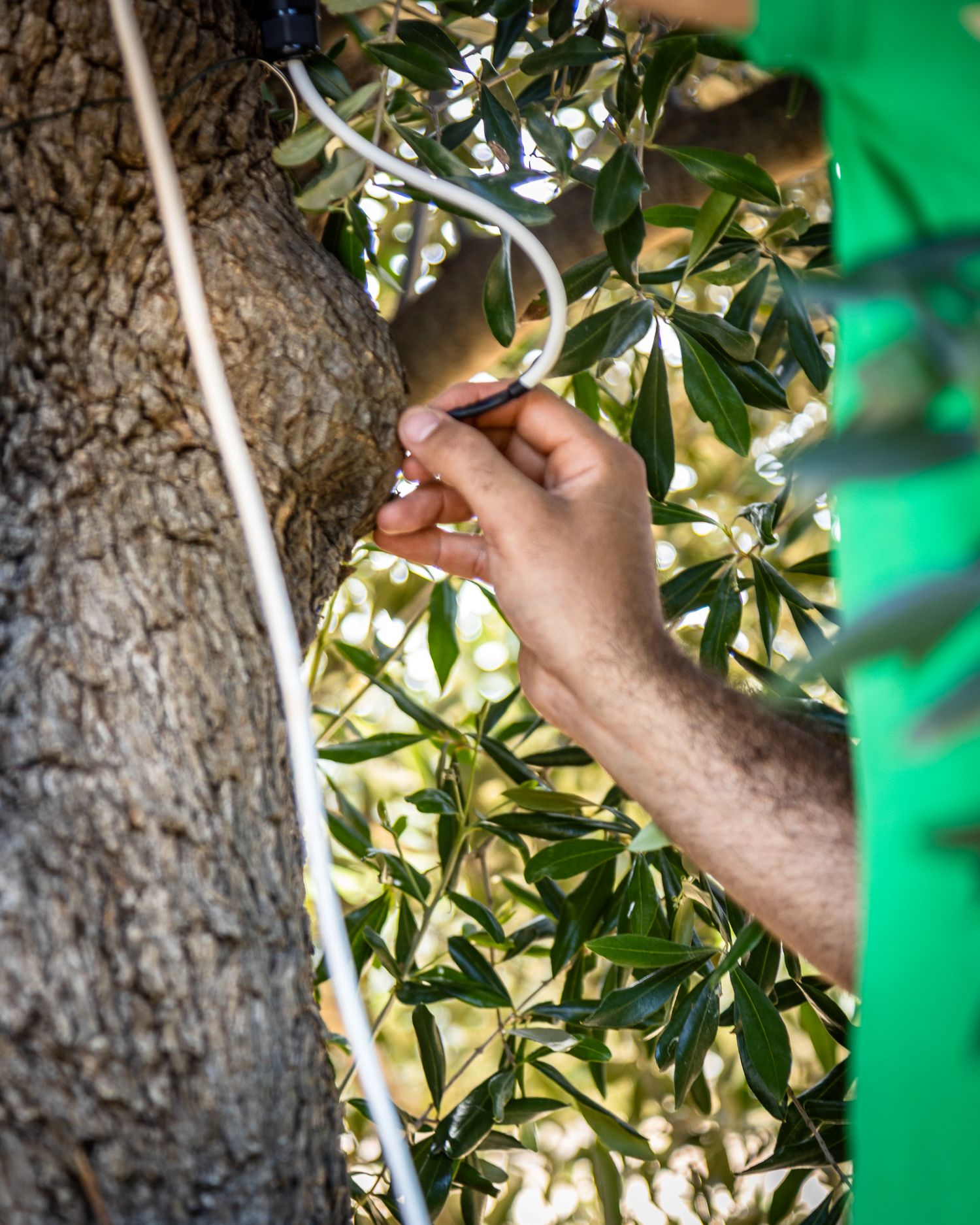
The process combines soil sampling, geospatial analysis, and satellite monitoring. Once the data is collected, an independent Validation and Verification Body (VVB) steps in. Their job is to check everything.
"The VVB will come to the field and will say: I have ascertained that the activities have actually been implemented. So the estimate, all the measurements that Radica have provided, correspond to the truth. And so the credits can then be issued."
It's a circle of accountability: the project developer, the registry, and the independent verifier all check each other's work. Credits are only issued after all three are satisfied.
Why some credits cost 50 cents and others cost 55€
This is the question that gets to the heart of the market's credibility problem. Francesco answered it directly.
Pricing starts with the farmer. Esférico calculates how much a farmer needs to earn in order to actually change their practices - typically between 150€ and 250€ per hectare. An olive grove, with four to five regenerative practices applied, sequesters around four to five tonnes of CO₂ per hectare. That means the credit can't be priced below roughly 50€ if the farmer is going to be fairly compensated.
"You can find credits for 50 cents in the market. So you can understand that when we are faced with this question - why does your credit cost 55€ when we can find credits for 50 cents - this is where you basically go in and explain the differences between one and the other."
On top of fair farmer pricing, Esférico adds non-delivery risk insurance and third-party ratings. Their Italian project is rated Triple B by BeZero - the equivalent of Standard & Poor's for the carbon market - placing it in the top 5% of all soil-based carbon projects globally.
What makes a credit compliance-grade
Francesco described three hallmarks that any serious carbon credit must meet:
- Additionality - the project creates impact that wouldn'thave existed without it. The carbon sequestered is genuinely new.
- Permanence - the carbon stays stored for a defined period.For Esférico, that's a minimum of 15 years per project, enforced through adouble buffer mechanism: 10% of credits held by the registry, another 10% heldinternally and only released to farmers who stay in the programme long term.
- Conservative measurement - credits are measured after the fact, never overstated, never double counted. As Francesco put it, a credit has to be measured "on an ex-post basis - you adopt the practice and then you measure."
Who buys these credits, and why
Demand spans the full range. Esférico sells to a doctor's office buying two tonnes and to Lufthansa buying at scale. The only filter is values; they don't sell to industries that conflict with their sustainability principles.
That demand is already outpacing supply. In Francesco's words:
"We have already sold more credits than we have actually generated so far, for future delivery."
What comes next
The EU's Carbon Removal Certification Framework (CRCF) is approaching, and registries including Esférico's are already adapting their methodologies to align with it. Full regulatory alignment is expected around 2027. Esférico is preparing now.
The programme is also shifting from individual farmer onboarding to a cooperative model, allowing hundreds of farms to join at once through a single partnership, rather than one farmer at a time. It's how they plan to reach 500.000 hectares by 2030.
The carbon market has a credibility problem that won't be solved by better marketing. It'll be solved by projects that are rigorous, built on real farms, verified by independent bodies, rated by agencies with no stake in the outcome, and designed to pay farmers fairly for work that actually matters.
That's what a high-integrity carbon credit looks like. And that's what Esférico is building.
5
min read
The coolest summer of the coming years
Decades of ignoring scientific-based warning have led us to where we are, and it doesn’t look like it will get better anytime soon. Neither climate nor policy wise.
Dear community,
Three years ago I published an article in a Portuguese newspaper called Welcome to the future we created. I wrote it in March when it was snowing, but the forecast for the following weekend was 27ºC, and the public water fountains in Barcelona had been sealed because of the drought.
Decades of ignoring scientific-based warning have led us to where we are, and it doesn’t look like it will get better anytime soon. Neither climate nor policy wise.
The consecutive years of “the hottest summer ever” in the news have not been enough to foster global action: the Economy always prevailed, as if one thing could exist without the other, and the “record breaking” speech carries a feeling we have reached some sort of peak that won’t easily be reached again.
Catarina Barreiros, a Portuguese sustainability content creator and entrepreneur, put it in an ironic manner: “Don’t always see the glass half empty, think of it as the coolest summer of the coming years.”.
Science says we are about to reach a new tipping point from which there is no return: when system alterations are so significant that self-reinforcing feedback loops start to drive unstoppable major changes on their own. It starts with climate, impacts nature, disrupts society and ultimately erodes the economic system decision-makers were trying to protect in the first place.
In recent years, most extreme forecasts, such as droughts, forest fires, and floods, have become reality. Because of the urgency, adaptation is now the main priority, but crisis solving, as opposed to prevention, poses the risk of excluding the most vulnerable.
Barcelona built its own climate shelter network - climatized, accessible and free interior spaces such as public libraries or community centres - and many other cities are following. In Sweden, there are new regulations on indoor temperature in the work environment, public buildings, or elderly homes. And if we look at other cities in different parts of the world - like Medellin, Linz or Istanbul - they have turned to planting trees to mitigate rising temperatures. New York has just announced it will do the same.
Regeneration is also growing as part of the solution since it’s no longer enough to use less than the planet can generate. We need to recover degraded environments. But can we meet our production and lifestyle needs while fostering nature’s recovery? I believe so, and on this topic, I saw two hope-filling documentaries worth watching: Groundswell and Kiss the Ground.
Where we decide to put our money is not apart from all of this, and as Antonio Miguel, founder of Maze, often puts it, “Impact is the greatest investment opportunity of our time”. That’s because climate isn’t the only problem our money can solve. Every euro invested is also a choice about the social, economic and environmental future we want to build. This quarter, we saw once again what that money, moved with intention, can achieve.
Highlights of the quarter
Focusing now on the positive, the last quarter gave us plenty to be proud of, and a few signs of where Goparity is heading next:
A community that shows up fast - six campaigns this quarter were fully funded in under 24 hours. Behind each of those numbers is a promoter ready to make a difference, and a community that keeps proving it wants to see positive change without hesitation. It is one of the clearest signs we have that trust in this mission keeps growing.
The impact behind the operation - every project funded this quarter adds up. Across 11 projects, our community helped avoid more than 1800tonnes of CO2, generate over 4800 MWh of clean energy, and support progress across 12 of the UN's Sustainable Development Goals. It's a reminder that this diversity, of sectors, of goals, of people involved, is exactly the point.
A new look and a new home page - our new website shows how we keep progressing and rethinking the way we communicate to better reflect who we are, why we’re here and where we're going. You will find the same logo, same values, same mission, but the voice, the look and the way we tell our story needed to catch up. All the images used are real photographs of projects we've financed together. Goparity is becoming a platform where you can find every way to invest sustainably.
Bolsa Social integration is in motion - integrating Bolsa Social in Goparity has reached an important milestone. After the acquisition, we ran three equity campaigns that mobilised over 365.500€, backed by more than 100 investors. Bolsa Social has now closed registrations for new users and will not open further campaigns of its own, with all new investment opportunities, in loans and equity alike, now concentrated on the Goparity platform.
News from promoter
One of our promoters has some news worth celebrating. Code for All, the Portuguese tech education company, has just been ranked 19th in the world in TIME and Statista's ranking of the top 500 EdTech companies globally, sitting alongside names like Duolingo and Coursera. It's the only Portuguese company on the list, and the 4th best in Europe.
It's a well earned recognition for a mission that's been running for over a decade: making relevant, up to date tech skills accessible in a fast-changing job market. Since 2025 alone, Code for All has trained more than 5.000 professionals in AI and supported over 60 companies in building those skills internally.
A great reminder of the kind of impact that keeps growing quietly, project by project, long after the initial investment. Code for All has funded 500.000€ throught Goparity in 4 successful campaigns: Code for All, Code for All II, Code for All III, and Code for All IV.
Congratulations to the whole team. 🎉
What's coming up
Very soon, you can expect a campaign from Cooperativa Agraria Sangareni, a smallholder coffee cooperative in the Peruvian Andes. Founded to serve farming families along the Ene river basin, it brings together 379 families across six communities, growing organic speciality Arabica coffee. A third of its members are women, who manage their own Fairtrade organic volumes. The funds raised will finance the purchase of green coffee during the 2026 harvest season, ensuring smallholder families in the Peruvian Andes receive prompt, fair payment for their harvest.
The campaign will offer a 6-month maturity with a 9,95% yearly interest rate. More details soon.
You can simulate your investment here.
The Impact Angels Club is open
As you may know, Bolsa Social had a history of equity investment, including successful exits, which we'll build on with Goparity by launching equity investments on the platform, alongside a new edition of the Impact Angels Club.
Goparity's Impact Angels Club, starting to operate in Q1 2027, is a private investor club making equity investments in early stage startups with high growth potential and impact well embedded in their business model, meaning companies that generate societal and environmental benefits as they grow.
We're not starting from scratch. This will be the second edition of the club, building on Bolsa Social's Impact Angels Club, one of the most distinctive initiatives in Spain's impact investing space, gathering some of the country's leading angel investors and much loved startups.
Over four years, the club made 11 investments, including companies like CoCircular, Recovo, Orygen, Leemons, Banbu, Showee, Robopedics, MiniTales, Visualfy and Naria.
It is a 30k€ commitment, spread across 4 years in 4 capital calls, with quarterly demo days to get to know and vote on pre screened investment opportunities.
Members get priority access to impactful investment opportunities, quarterly investment committee meetings (virtual or in person), network events, webinars, and one yearly gathering.
The last edition had 40 participants and was oversubscribed. This time, it will be limited to the first 100 members. It's important to mention that those who were part of the previous edition will be given priority in the new club, and the first confirmations have started to come in.
If you're interested in learning more, please fill out the form below and I'll schedule a meeting with you.
Musical note
When I was younger, I used to DJ, mostly electronic music, and I still listen to it a lot. Here’s a song I’ve been playing lately: The Adventurer by French 79. It caught my attention for the lyrics and stayed for the bass: "It’s time to see the bigger game. We need to kick those bloody self-absorbed thoughts to the curb. It’s time to stop thinkin’ just about ourselves and start givin’ a toss about others."
As always, feel free to reach out to our team if you have any comments or questions.
5
min read
How much could you be making if you invested in every project we funded?
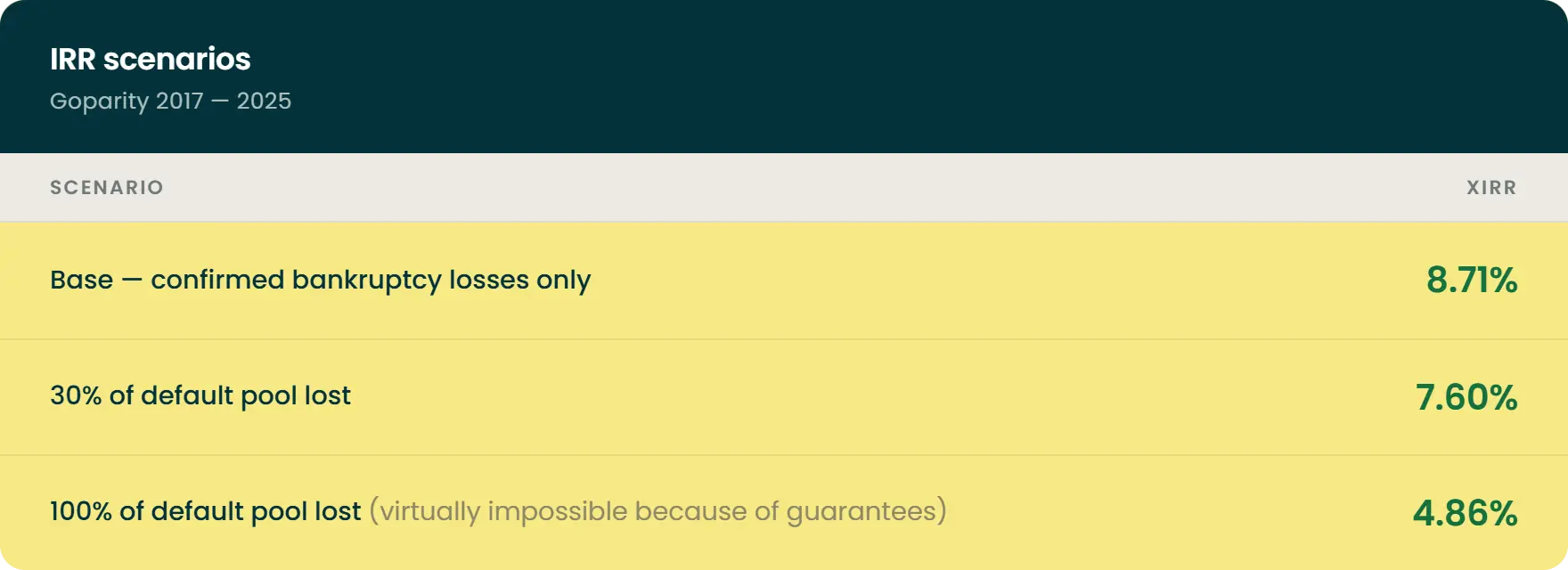
We measured Goparity's loan portfolio since the creation of the company: it has delivered an average annual return of 8,71% to investors. That figure accounts for every euro invested, every repayment of principal and interest received, and the value of the loans outstanding at the end of December 2025, deducting the losses.
Portfolio Performance
We measured Goparity's loan portfolio since the creation of the company: it has delivered an average annual return of 8,71% to investors. That figure accounts for every euro invested, every repayment of principal and interest received, and the value of the loans outstanding at the end of December 2025, deducting the losses.
To test how solid that number is, we ran two deliberately pessimistic scenarios:
a) If 30% of the loans currently flagged as at-risk were never repaid, the return would ease to 7,60% per year.
b) Even in the extreme case where every single at-risk loan was written off completely - something the guarantees behind these loans make virtually impossible - the portfolio would still have returned 4,86% per year.
In other words, the returns hold up well even when we assume the worst, without mentioning the impact achieved.
Don’t just take our word for it
Pedro Andersson, a well-known Portuguese journalist and author specialising in personal finance, creator of the Contas-poupança project, invested 1.000€ in Goparity, in another P2P platform and in Portuguese state savings certificates. Every month, he reports transparently on the results.
5
min read
What's Left When the Fire Moves On
Last week, a fast-moving wildfire tore through Ontario’s Namaygoosisagagun First Nation, also known as Collins First Nation, an Indigenous community in northwestern Ontario, Canada, north of Thunder Bay.
Last week, a fast-moving wildfire tore through Ontario’s Namaygoosisagagun First Nation, also known as Collins First Nation, an Indigenous community in northwestern Ontario, Canada, north of Thunder Bay. Homes and buildings were destroyed. Evacuees are now sleeping in their cars in Thunder Bay, because there are no vacant hotel rooms left for them. Armstrong, Whitesand First Nation, Gull Bay First Nation, Lac des Mille Lacs First Nation and Lac La Croix First Nation have all been ordered out too, most of them relocated south along the same overwhelmed corridor.
It's worth sitting with what that actually means. Not a hectare count. A home.
We've seen what comes after. In July 2024, wildfire tore through Jasper, a national-park town in Alberta, destroying 358 of the townsite's 1,113 structures in a matter of hours. Two years on, the rebuild is still grinding forward. As of this spring, only 16 homes and buildings had been fully recovered, with another 75 under construction, out of more than 370 destroyed properties. Families spent that time in apartments, campsites and rentals, watching their neighbourhood slowly become, as one resident put it, “someone else's neighbourhood instead”.
That's the part that doesn't make it into the hectare counts and fire-danger maps: losing a home isn't a single bad night. It's a multi-year process of paperwork, insurance calls, and waiting, often in a town that no longer has the housing stock to hold everyone while they wait.
A different way to build
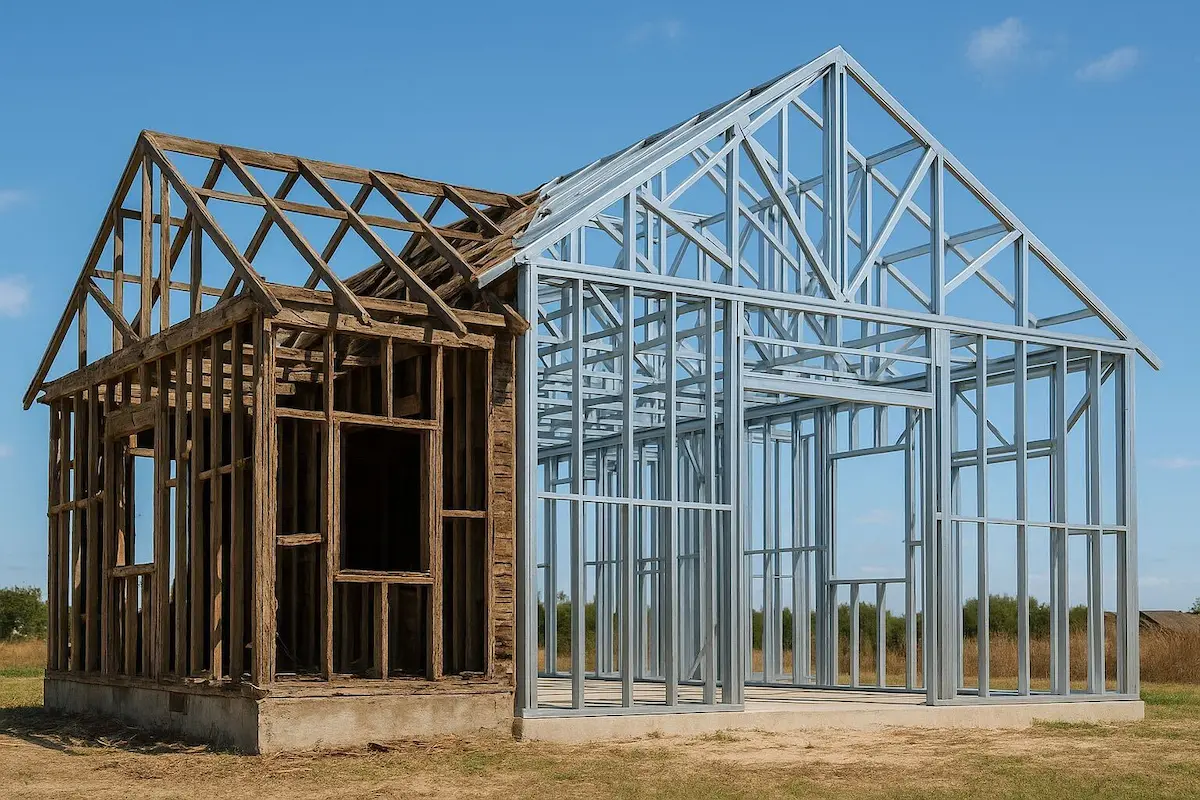
One of our Canadian borrowers, Build Smartr is trying to change that math. The British Columbia-based company founded by Harv Sidhu manufactures prefabricated steel-frame wall panels, joists and trusses for homes and low-rise buildings, in place of conventional lumber framing. Their steel frames are dimensionally stable, made from up to 99% recycled material, and don’t burn.
Build Smartr’s business is built around a version of this question: if we know homes are going to face more fire, more flood, more extreme weather, why do we keep building them the same way?
"We need to build more resilient buildings that withstand forest fires…" Sidhu said in a 2025 conversation with the Goparity Canada team. "…buildings and homes that will last longer or take less damage. We're really seeing steel be a major player in that space, being that it creates non-combustible homes. We need to make homes stronger to make them last longer."
Build Smartr's break came when BC Housing needed a contractor for an eight-storey building in Langley, near Vancouver after an earlier version of the project, framed in wood and roughly six storeys up, burned down mid-construction. The city responded by requiring the rebuild to be non-combustible, and Build Smartr's steel framing fit the requirement. As Sidhu told Canadian Manufacturing, steel's advantage is that it's stronger, it lasts longer, and it isn't combustible, an argument that gets harder to dismiss with every fire season.
Where Goparity fits in
We've now financed three separate campaigns with Build Smartr through our platform, totalling CAD $220,000 (around 137K euros), the most recent closing this past January. That money came from hundreds of everyday investors who pooled their investments to back a company working to build homes that are more resilient when wildfires strike.
We're not going to pretend that's a solution to what's happening in northwestern Ontario right now, or to what Jasper is still living through two years later. It isn't. Materials don't stop a fire on their own, and no framing system fixes the underlying problem of a hotter, drier climate producing more dangerous fire seasons. Builders who followed every provincial guideline of FireSmart, Canada’s wildfire-preparedness programme, have still lost homes this year.
What it is, is one example of the kind of choice that gets made long before a fire ever starts, in a lumber yard or a steel shop, months or years before anyone is evacuating. We think that choice is worth funding, and worth talking about, even in a week when it's hard to talk about anything else.
If you're one of the thousands of people currently displaced in northwestern Ontario, or watching someone you love go through it, our thoughts are with you.
If you're looking for a way to help directly, the Anishinabek Nation 7th Generation Charity is collecting donations specifically for Namaygoosisagagun First Nation, covering emergency supplies, temporary shelter, and essential resources for the community named above. The Canadian Red Cross's Canadian Wildfire Fund is supporting the broader response across northwestern Ontario, including evacuee services in Thunder Bay.
5
min read
Diversification: What It Really Means and How to Achieve It
Diversification is one of the main talking points in conversations around investment advice. Ever since markets have become more accessible, there has been a strong emphasis on the importance of having a diversified portfolio, but what is diversification, and how can it really be achieved?
Unsystematic and systematic risk
Diversification is one of the main talking points in conversations around investment advice. Ever since markets have become more accessible, there has been a strong emphasis on the importance of having a diversified portfolio, but what is diversification, and how can it really be achieved?
Everyone knows that risk is an inevitable part of investing, after all, there are no free lunches. Typically, when choosing investments we're exposed to two types of risk: unsystematic (also called idiosyncratic) and systematic. The first is firm-specific risk, it can be the risk associated with unfavourable litigation, a natural catastrophe that impacts a company's headquarters, and so on. The second is market risk, and it relates to the degree to which an investment moves with the overall market.
Building a diverse portfolio
This is the part where diversification comes into play. In essence, diversifying a portfolio means spreading investments across several different assets to help manage both types of risk (though, as we'll see, it doesn't do so equally).
By holding a portfolio of, say, thousands of stocks, each with a relatively low weight, you reduce the impact of any single company-specific event. If one holding suffers a bad outcome, it's unlikely to have a meaningful effect on the performance of your overall portfolio. This is diversification doing what it does best: eliminating unsystematic risk almost entirely.
With systematic risk, things are not as linear. This is the risk inherent to being exposed to the market itself, it’s driven by broad forces like interest rates, inflation, or recessions that touch nearly every asset to some degree. You can combine asset classes that have historically had low or negative correlation (i.e. whose returns haven't historically moved in the same direction and to the same degree) to smooth out the overall volatility of your portfolio. However, this won’t entirely erase systematic risk as historical correlations are not a fixed law.
Stocks and bonds are the clearest recent example. Historically, both these asset classes had an inverse relationship, with the long-term return correlation between equities and bonds having been broadly negative since the 1990s. However, that changed in 2022, with that year representing the first time that both equities and bonds had experienced negative returns in the same year since 1977. While some data shows this inverse relationship partially resuming in 2023, this is still a reminder that historical correlations between asset classes aren't a fixed law and can shift with the macro environment.
Common diversification mistakes to avoid
While diversification is a crucial strategy for managing investment risk, investors should watch out for a few common pitfalls:
- Over-diversifying. Spreading money across too many funds with overlapping holdings doesn't add much protection (it might just increase investment cost and complexity, without meaningfully reducing risk any further).
- Mistaking "different" for "uncorrelated." Real diversification means choosing assets that don’t move in the same direction at the same time. For example, buying gold, silver, and platinum might look like variety, but because these metals often behave similarly, they don’t provide the kind of diversification investors usually aim for.
- Skipping rebalancing. Portfolios drift as some holdings grow faster than others. Without periodically rebalancing back to target weights, a portfolio can end up far more concentrated and far riskier than originally intended.
Also don't forget that you can diversify by spreading your investments across various industries (like technology, health care, energy, and financials), across several geographical regions, market capitalizations, investment styles, and so forth.
Bottom line
Diversification is a core approach to managing investment risk and supporting long‑term growth. While it doesn’t guarantee profits or eliminate losses, building a well‑diversified portfolio can help reduce the impact of market ups and downs and lead to more stable returns over time.


.webp)


.webp)

.svg)

.svg)


.svg)

.svg)
.svg)
.svg)
.svg)
