

Iara Comunello

Iara Comunello

Impact Manager

From Brazil, but with many places to call home, Iara is fascinated by the complexities of the world and curious about new ways of making a difference. With a degree in International Relations and a Master's in International Development and Cooperation, for her, this curiosity wasn't just intellectual - it was a call to action.

At Goparity she is the focal point for everything that has an impact- from funded projects to acceleration programs and certification - ensuring the impact is measurable, tangible and transparent.

Discover

Iara Comunello

articles

Thank you! Your submission has been received!
Oops! Something went wrong while submitting the form.
Learn

5

min read

Theory of Change

Understand how moving your money towards what your values is part of the change. Goparity’s theory of change describes the path we can take – from connecting investors to impactful organisations, redirecting finance to solve our social and environmental challenges, reducing the sustainability funding gap, building and spreading knowledge. Learn more.

A Theory of Change describes and illustrates how and why a desired change is expected to happen in a given context, providing a roadmap for the financial and non-financial interventions required to bring it about.
Goparity’s theory of change describes how a community-based impact finance platform can redirect financial flows, so that more impact-driven organizations can emerge and grow, while a greater share of society actively participates in transforming the economy.


The problem

‍
The current economic system is increasingly detached from real-world needs and the promotion of the common good, failing to internalize the social and environmental impacts and long-term costs of economic activity. At Goparity, we believe that the system that has caused this damage can and should be part of the solution.
Several structural drivers reinforce this dynamic: less than 1% of global financial assets are directed to sustainability and development; traditional banking continues to finance harmful industries; and individuals and organizations largely lack visibility on how their money fuels negative impacts.
This results in unequal and insufficient funding for sustainability and development, accelerating environmental degradation and eroding social well-being, while financial and impact literacy remain low among people and organizations. The consequences include a persistent 4 trillion USD global sustainability funding gap, continued environmental damage and weakening social cohesion, and limited awareness of financial alternatives that would allow people and organizations to align their choices with their values.  
‍

The solution

‍
Goparity connects organizations to dedicated sustainability funding while empowering individuals to align their financial decisions with their world views and values. By catalyzing this connection, we raise awareness and strengthen financial and impact literacy among both people and organizations.
Through this approach, Goparity works towards a vision of an impact economy in which financial flows systematically support organizations with an impact purpose and where people and assets are consistently directed towards addressing social and environmental challenges. In this vision, agrifood systems, the blue and green economy, the social economy, and the energy system are all transformed so that production is sustainable, communities are resilient and inclusive, and energy is clean, affordable, and efficient.
‍

The outcomes for key actors

‍
For investee organizations, access to funding reduces their financing gap, enabling them to sustain and scale their operations while delivering solutions to social and environmental challenges. Impact assessment and advisory support deepen their impact literacy and strengthen their capacity to understand, manage, and enhance their social and environmental performance.
For investors, the platform increases the proportion of their finances allocated to impact, supports the growth of their savings or investable resources, and improves their financial and sustainability literacy. This contributes to greater financial autonomy and a stronger sense of impact agency.
‍

Systemic and thematic impacts

‍
Through the projects it finances, Goparity applies this Theory of Change across several thematic areas, contributing indirectly to systemic transformation in agrifood systems, the blue and green economy, the social economy, and sustainable energy.

  • Sustainable energy: Contributing to the expansion of sustainable energy infrastructure, increasing clean energy production, and avoiding CO₂ emissions.
  • Green economy: Supporting job creation, reducing energy intensity, increasing recycling rates and water-use efficiency, and expanding areas that are protected, certified, or under Indigenous-led protection.
  • Agrifood systems: Increasing the share of land under sustainable agricultural practices, reducing food loss and waste, and improving the productivity and incomes of small-scale food producers.
  • Blue economy: Contributing to the expansion of marine areas that are protected or under Indigenous management, increasing the share of sustainable fisheries, and reducing food loss and waste across blue value chains.
  • Social economy: Beyond job creation, enhancing access to essential community services for the population, such as health, education, culture, and other foundational services that strengthen social cohesion.
Learn

5

min read

Your money has a carbon footprint

Money sitting in a bank has an impact, and likely a negative one. The world's 60 largest banks have increasingly financed the fossil fuel industry. Goparity offers an alternative: direct your money towards real-world solutions.

Does it surprise you to learn that banking and investing activities are not climate-neutral? When we connect these topics, we are talking about applying a climate lens to financial management.

The money existing in any bank serves a purpose – banks will lend and invest across the economy. Banking institutions have a power to direct money and influence outcomes, and the activities they choose to finance, matter.  

In the Paris Agreement, nations of the world collectively agreed on limiting global warming levels to 1.5º above pre-industrial levels, intending to reduce greenhouse gases emissions and act against climate change and its harsh consequences on people and the environment. However, reports have found that since 2016, when the Agreement was adopted, the world’s biggest banks not only have continued financing industries with high levels of emissions, but they have increased funding fossil fuel expansion – meaning new extraction projects. These reports vary from $5.5 trillion to $7.6 trillion committed to fossil fuel financing in that period.  

By consequence, your money and your savings in the bank, however big or small, are most likely being used to fund fossil fuel activities and even expand them. The issue feels bigger when individuals and companies are unaware of alternatives to align their finances to their values and to contribute to positive impact. The good news is that most people want to act based on their values using their money: a comprehensive study found that 69% of the global population would be willing to contribute 1% of their personal income towards climate action.

Goparity intends to fill the alternative gap with a community-based solution, giving people and organisations back the choice on what is financed with their money. By redirecting capital from high-emitting industries, Goparity acts as a connector among investors and impactful organisations that work towards real-world solutions in sustainable energy, the blue and green economy, agrifood systems and a social economy.

Learn

5

min read

Fixing the funding gap

$4 trillion is missing from development financing. That is just 1% of global financial assets. Through the platform, that capital can be redirected to support the energy transition, stronger communities, and resilient ecosystems.

In 2025, ahead of the Fourth International Conference on Financing for Development (FfD4), the OECD released a report on Financing for Sustainable Development stating that in the past ten years, the SDG financing gap has grown by 60% reaching USD 4 trillion. That means – resources are missing where they are needed the most.

Interesting to notice, however, that the global financial assets total over USD 461 trillion, 40% of them coming from private banks. which confirms that the resources needed exist, but prioritise returns over developmental impact. In fact, around 1% of global financial assets could close the SDG financing gap.  

That means that private sector financial flows, that already exist, must be redirected to close the gap, advancing and reaching the SDGs, and addressing vulnerabilities.  

The OECD recognises and highlights the importance of private financial flows, especially through innovative finance, such as blended finance, impact investing and green bonds, to facilitate investment flows into sectors that are critical to sustainable development, “unlocking resources and enabling a more equitable distribution of global wealth in support of inclusive and sustainable growth”. At the same time, rigorous measurement frameworks are needed to ensure a real contribution to the SDG outcomes.

Goparity is at an intersection of these possibilities – through innovative finance instruments, such as crowdlending and crowdequity, and the intention of a community of investors, money is directly supporting organisations that are working to avoid and reduce harmful activities, benefiting people and communities and contributing with solutions to real issues. And to ensure that the funded activities contribute to SDG outcomes, Goparity partnered with the UNDP initiative ALtFinLab to strengthen data and impact metrics framework. Through transparent and clear information, investors have the choice on the destiny of their money.

Announcements

5

min read

Our impact framework just got stronger

Goparity has partnered with UNDP AltFinLab, a United Nations initiative at the forefront of alternative finance, to strengthen how we measure and report impact in crowdlending.

Goparity has partnered with UNDP AltFinLab, a United Nations initiative at the forefront of alternative finance, to strengthen how we measure and report impact in crowdlending.

We led a structured review of our impact management framework, with technical mentorship from the UN.

‍

United Nations - Alt-fin Lab logo

‍

The work covered three phases: aligning our impact objectives with measurable indicators, updating our project categories, and improving how we collect and manage data. The result is a more transparent and more SDG-aligned framework.

Learn more bellow ⬇️

‍

A rigorous review

Impact cannot rely on intention alone. It must be measurable, comparable, and credible.

‍

🗂️ Project categories

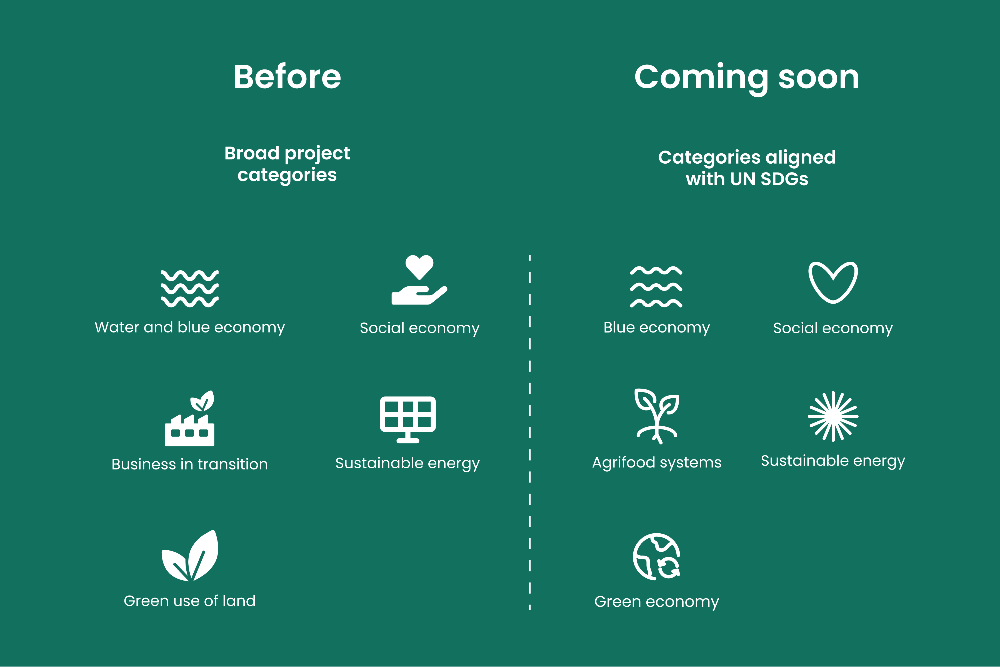
Our updated project categories bring a new level of clarity and rigour to the way we classify and compare investments. Each category is now more precisely defined, more directly aligned with global impact priorities, and easier to compare across projects - so you always know exactly what kind of change your money is contributing to.

‍

Before and after project categories - new impact framework

‍

Most importantly, every category is now more directly connected to the UN's 2030 Sustainable Development Goals, anchoring every project on Goparity to the international framework that defines what a better world actually looks like.

‍

📊 Project indicators

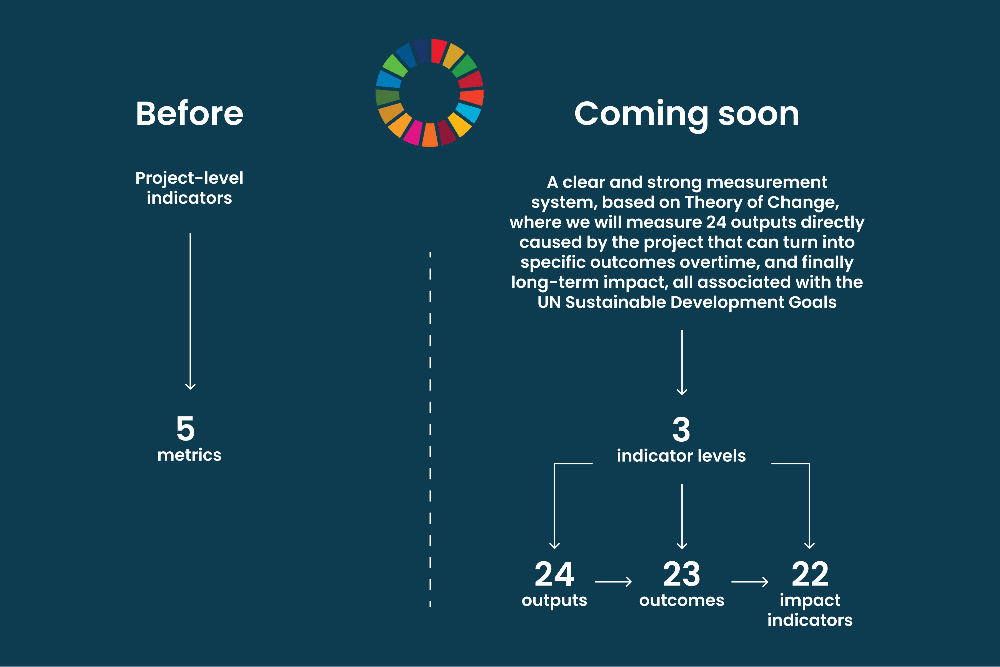
Our new framework is built on the Theory of Change, tracing direct project outputs through to long-term, real-world impact.

‍

Before and after project indicators - new impact framework

‍

Now, we can track 24 outputs, 23 outcomes and 22 impact indicators across three structured levels. The result is a clearer measurement logic, a more transparent link between projects and real-world outcomes, and better impact reporting.

‍

Why we took this step

This collaboration is an important step for Goparity. It allows us to reinforce the methodological foundations of our impact framework and ensure that our growth is matched by equally robust impact standards. As sustainable finance evolves, so must the standards behind it. We are committed to being on the right side of that evolution, and this is our clear stance against impact washing.

‍

"As sustainable finance continues to evolve, strengthening transparency, accountability and methodological clarity becomes increasingly important. Through AltFinLab, we support ecosystem actors so they can refine impact measurement approaches that align financial innovation with broader sustainable development objectives."

‍Teodor Petricevic - Accelerator Lead, UNDP AltFinLab

‍Read more on UNDP's blog

‍

What to expect next

While our Impact team is already using the new framework, we know you still can't see these changes when you log into Goparity. Over the coming months, our development, design, and product teams will work to bring these new categories and indicators to life directly on the platform.

We are committed to continually improving how we monitor, measure, and communicate impact, and we see this as an ongoing journey that we build with our community.

‍

We partnered with the United Nations Development Programme to raise the bar on how we measure, report, and stand behind our impact - so you can invest with even more confidence.

‍

Our impact

See how your investments help build a more sustainable and inclusive economy.

How to invest

Learn how to start investing in sustainable projects.